October 29, 2025•7 min read•By Maurits Dierick, Charter Broker & Former Yacht Captain
The Pirate Heist That Shook an Empire
A single pirate raid in 1695 shook the Mughal Empire. Henry Every’s heist of the Ganj-i-Sawai remains the most legendary in history.
The Pirate Heist That Shook an Empire
In the vast tapestry of history, great powers often fall not to massive invasions or internal revolutions, but to small, seemingly insignificant events that expose hidden weaknesses, much like how a single outlier can tip the scales in ways no one sees coming.
Consider the summer of 1695 in the turbulent waters of the Indian Ocean. A loose alliance of English pirates, led by a former naval officer turned rogue, spotted an opportunity in the form of the Grand Mughal Fleet, a convoy of 25 ships returning from the sacred Hajj pilgrimage to Mecca. This was no ordinary fleet. It carried pilgrims, merchants, and treasures that symbolized the might of the Mughal Empire under Emperor Aurangzeb. At its heart was the Ganj-i-Sawai, a colossal vessel built decades earlier, armed with 80 cannons and manned by 400 musketeers, representing the pinnacle of 17th-century maritime engineering.
What followed was a daring ambush that netted piracy's greatest haul. It didn’t just enrich a band of outlaws. It became a turning point that unraveled diplomatic ties, ignited the first global manhunt, and nearly dismantled England's fragile trading empire in India.
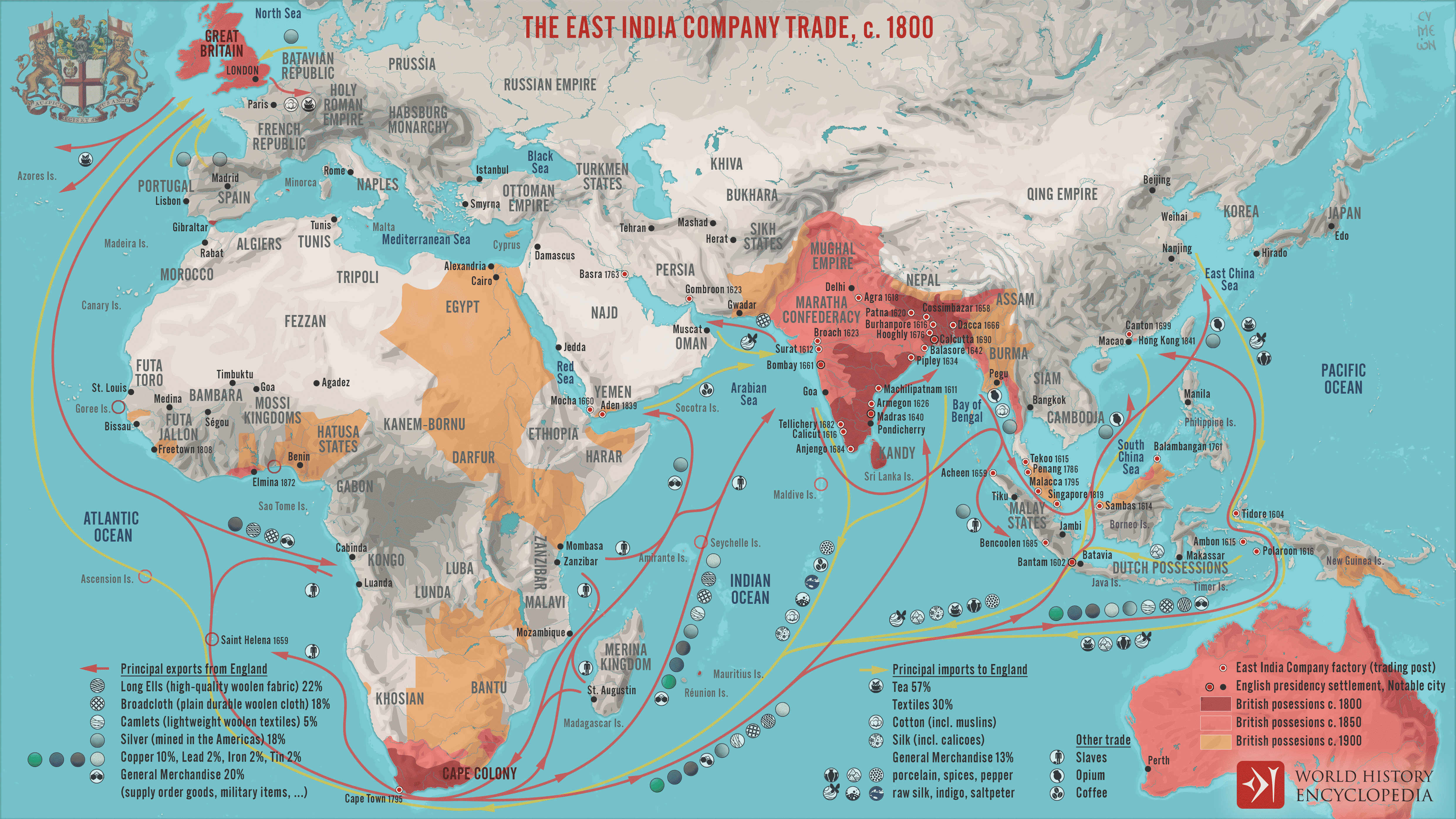
East India Company - Trade Routes
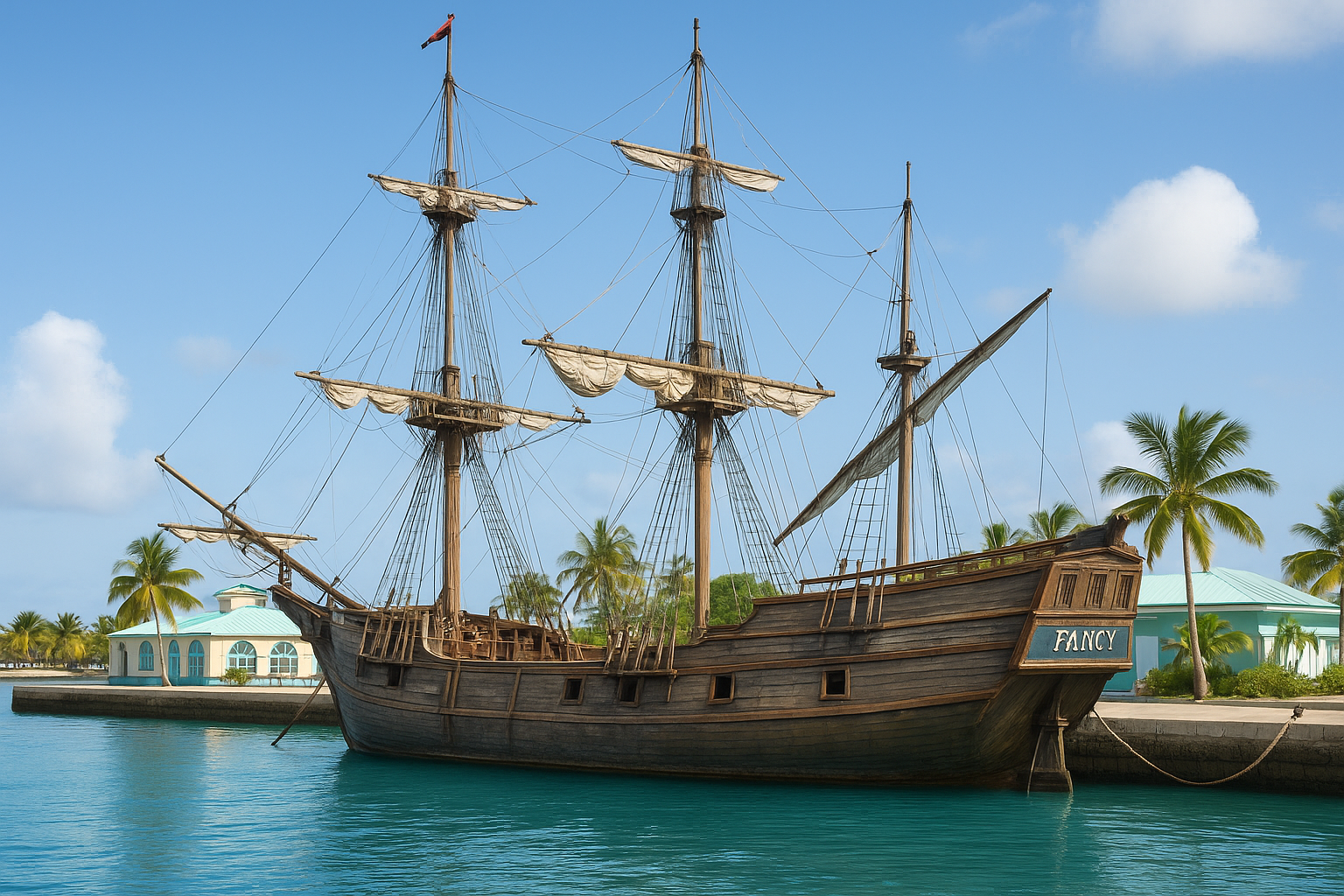
To understand this moment, we begin with the man at the center: Henry Every, sometimes known as John Avery or Benjamin Bridgeman. He was in his mid-30s, an Englishman shaped by the harsh realities of life at sea. Every began in the Royal Navy during the Nine Years' War, then moved into the slave trade as a mate on merchant ships. But frustration boiled over in May 1694 aboard the Charles II, a privateer vessel whose crew mutinied against unpaid wages and brutal conditions. They seized control, renamed her the Fancy, and set sail.
Browse the fleet
Crewed yachts for every kind of week on the water, from catamarans and sailing yachts to full-size superyachts.
Every, chosen as captain by his crew, embodied the pirate ethos: rebellion, opportunism, and ambition. He was no cartoon villain. He was a skilled navigator who promised his men no harm to English ships and a fair share of any fortune they captured.
By August 1695, Every had gathered a loose confederation in the Bab-el-Mandeb Strait, the choke point between the Red Sea and the Arabian Sea. His allies included seasoned pirates such as Thomas Tew on the nimble eight-gun sloop Amity with 46 men, Richard Want commanding the 60-man brigantine Dolphin, Joseph Faro’s Portsmouth Adventure with 60 men, Thomas Wake’s Susannah with 70, and William May’s Pearl with about 30 to 40. Together they numbered more than 440 men, all holding privateering commissions that blurred the line between legal plunder and open piracy. In a vote that reflected Every’s influence, they made him admiral, even though Tew was the most famous among them. Their target was the annual Mughal convoy, a rich procession of spices, silks, and bullion moving between Mecca and India.
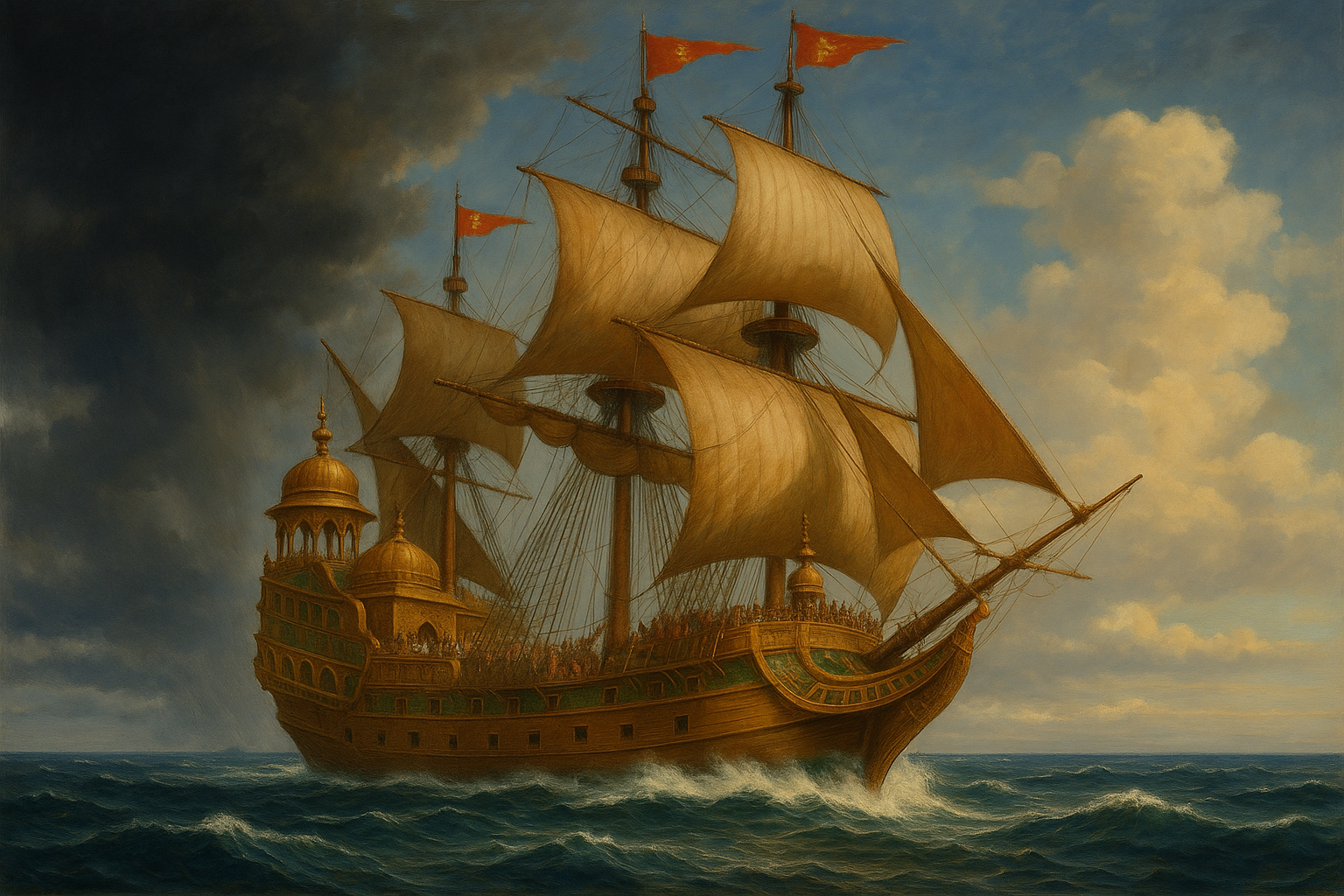
The Mughals were not unfamiliar with danger. Emperor Aurangzeb’s empire stretched across much of India, its wealth funneled through ports like Surat. The fleet was escorted by the imposing Fateh Muhammed, a 94-gun giant of 3,200 tons owned by Abdul Ghaffar, Surat’s wealthiest merchant, with an 800-man crew. The true prize was the Ganj-i-Sawai, or “Exceeding Treasure,” a 1,600-ton vessel built in 1614 under orders from Dowager Empress Mariam-uz-Zamani after the loss of her previous ship, the Rahimi. Captained by Muhammad Ibrahim, it carried 1,100 crew and 600 passengers, including pilgrims and high-ranking officials. Its cargo was essentially a floating vault.
The Ganj-i-Sawai | reimagined by AI
The pirates positioned themselves near the volcanic island of Perim, expecting to intercept the convoy. But the Mughals slipped past under cover of night, forcing a chase. The Dolphin was too slow and was burned, its crew absorbed into the Fancy. Tew’s Amity lagged after a clash in which Tew was killed by a Mughal cannonball, a grim omen. Four or five days later, the pirates overtook the Fateh Muhammed. The resistance was light and the ship yielded between £50,000 and £60,000 in gold and silver, an enormous sum but still small compared to what lay ahead.
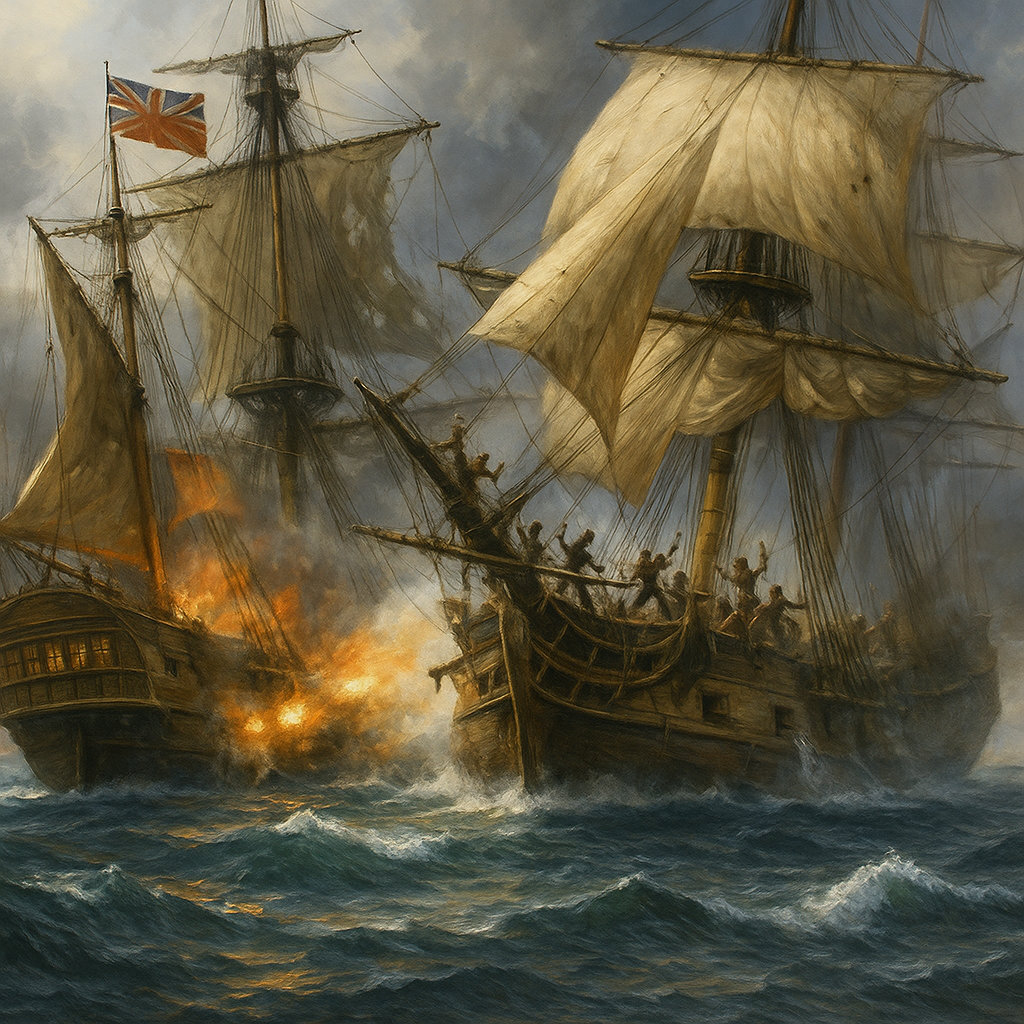
Only the Fancy, Pearl, and Portsmouth Adventure closed in on the Ganj-i-Sawai. Every’s opening broadside struck the Mughal vessel’s mainmast and sent it into chaos as -in a stroke of luck- its own cannons misfired and killed many defenders. Pirates boarded quickly, meeting fierce resistance. Captain Ibrahim armed enslaved women in a desperate final defense. What followed was a brutal two- to three-hour battle of musket fire, sword fighting, and hand-to-hand combat. The Portsmouth Adventure stayed back and did not engage, which later cost them their share. Pirate casualties were uncertain but the Mughals, leaderless after key officers fell, finally surrendered.
The aftermath was darker than the battle itself. Survivors and historians like Khafi Khan described scenes of torture, assault, and murder. Captives were brutalized as pirates searched for hidden treasure. Women, including pilgrims and a relative of the emperor, suffered terrible violence. Depositions from captured pirates, including John Sparkes and Philip Middleton, later confirmed these horrors, showing how quickly the crew abandoned any supposed code of conduct.
Ready to start planning?
Tell us what you have in mind and a broker will put together a tailored selection, with honest review notes and walkthrough videos.
The loot was unprecedented. Estimates ranged from £200,000 to £600,000 from the Ganj-i-Sawai alone, amounting to around £115 million in today’s terms. Adding the Fateh Muhammed’s treasure and other prizes such as the Rampura, the total made this the richest pirate haul in history. On Réunion Island in November, the spoils were divided. Each man received about £1,000, equivalent to a lifetime’s wages, along with gems. Every and the other captains took double shares. They even purchased 90 enslaved people to handle the labor on their voyage.
The news of the attack spread like wildfire. When the Ganj-i-Sawai limped back to Surat with stories of the desecration of Hajj pilgrims, Emperor Aurangzeb was furious. Already resentful after prior conflicts with the East India Company, including Child’s War, which had slashed English trade, he retaliated with force. He closed four Company factories, imprisoned English officers, and besieged Bombay, demanding £600,000 in reparations. The Company was forced to pay and promise justice, but its standing in India was severely shaken.
In England, the Privy Council declared the pirates enemies of all mankind. A £500 bounty, later doubled, was issued for their capture. The hunt for Henry Every became the world’s first truly international manhunt. Colonial governors were alerted. The Board of Trade coordinated a global response. Piracy, once a murky legal gray zone, was now treated as a universal threat.
The pirates’ escape added to the legend. After dividing the loot, the Fancy reached Nassau in the Bahamas by March 1696. There they bribed Governor Nicholas Trott with £860, ivory, arms, and powder. Trott welcomed them as “independent traders,” but when the royal warrant arrived, he secretly warned Every. The pirate fled aboard the Sea Flower with a small crew and vanished after reaching Ireland with his treasure. The Fancy was scuttled or wrecked, and only 24 crew were eventually captured. Five were hanged in London in front of large crowds. Every’s fate remains unknown, spawning stories of hidden treasure and a quiet death in obscurity.
The Fancy - Docked in Nassau, The Bahamas. | Reimagined by AI
The raid’s consequences were profound. It damaged the East India Company’s fragile position, forced new agreements with the Mughals, and triggered reforms that reshaped global trade. Anti-piracy laws tightened and international cooperation increased. Henry Every became a legend, celebrated in ballads and stories as the “Arch Pirate,” inspiring others to follow his path even as the golden age of piracy began to fade.
This was not just a theft. It was a demonstration of how vulnerable empires can be when distant events pull at their threads. One raid, carried out by a handful of men at sea, exposed the fragile web of trade, diplomacy, and ambition that bound the early modern world together.
If you’re curious to explore the very waters where this chapter of history was written, we’d love to take you there. Our name, Frontier Yachting, wasn’t chosen by chance. We specialize in off-the-beaten-path destinations, far from the crowded routes, and bring curious travelers closer to the places where legend and history meet.
Get in touch at hello@frontieryachting.com and let’s chart your own course through these remote and mysterious waters.



-1781247496193-d1d1ivam-4ef46010.webp&w=3840&q=75&dpl=dpl_7S4kHxq6kNUPyuFBqACLFnkzWz33)

