Greece, Croatia, the south of France? Where you charter matters as much as the boat. A region-by-region guide to the Mediterranean
Where to Charter a Yacht in the Mediterranean
People come to us with a nice problem to have. They want a week somewhere in the Mediterranean and they've no idea where. Greece? Croatia? The south of France? It's a big place, and the honest answer is that it depends on the week you want.
I've spent years on and around this water, first as a captain, then as central agent managing charter yachts all over the world and now matching people to yachts at Frontier. I've long stopped thinking of the Mediterranean as one place, as it's really a dozen different holidays sharing the same sea. A week in the Cyclades in August and a week in the Bay of Kotor in June have about as much in common as a hiking trip and a city break - ok, that might be exaggerated, but you get my point. So before we get to any single region, it's worth thinking about what you actually want the days to feel like, because that quietly settles a lot of the question for you.
Start with the week, not the map
The easy mistake is to begin with a place you've heard of and work backwards. It tends to go better the other way around, though both are possible obviously.
To start, the thing that shapes it quite a bit is how much ground you want to cover, and how easy you want the going to be. Some of these waters are gentle: short hops, sheltered bays, an afternoon breeze that turns up politely and a sea that stays calm under you. Others are more open, with room for the wind and the sea to build and longer legs between stops. One suits a family with small children who want flat water and a beach by lunchtime. The other suits a crew who came to be on the move and don't mind a lively afternoon. The Mediterranean has both, often within a short flight of each other, and it matters little whether your boat is a motor yacht, a catamaran or a sailing yacht: the question is the pace of the week, not the rig.
Then there's the shape of the cruising. Some regions are made for island-hopping, where you wake up somewhere new most mornings and the chart is dotted with options. Others are really a coastline, where you work along the shore from one town to the next. Island-hopping feels more like an adventure and gives the captain more to play with around the weather. A coast can be the easier, more predictable choice when you want the towns and the restaurants as much as the time on the water.
It also helps to be honest with yourself about how lively you want it. A few of these places are social and full of scene in high summer, with busy harbours and a long lunch that turns into a longer evening. Others are quiet almost everywhere you drop the anchor. Plenty of people want a bit of both across one week, which is its own useful answer.
The last big lever is timing, and it matters enough that it gets its own section further down, because the same region can feel like two different places in June and in August.
The boat is its own conversation, of course. A catamaran, a sailing yacht and a motor yacht give you very different weeks in the same bay, and we get into how to choose in our guide to the different types of charter yacht. And if the whole process is new to you, our guide for first-time charterers walks through how a charter works from the first call to stepping off at the end. This piece is only about the where.
Tell us the week you have in mind
Free to ask. We reply within 8 hours.
We read every enquiry ourselves. We reply within 8 hours. No call centre, no auto-responder.
Greece
Greece is the one most people picture first, and it lives up to the picture. What surprises people is how many different Greeces there are. At least five, really, and they are very differently from one another.
The Cyclades are the postcard: Mykonos, Santorini, Paros, Naxos, Milos, white villages above a deep blue sea. This is open-water island-hopping with proper distances between the islands, and in high summer it has a character all of its own thanks to a steady northerly wind called the Meltemi. The Meltemi is what gives the Cyclades their famously clear air and dry heat, and experienced crews love it because it means real, reliable wind for anyone who really wants to sail. It can also blow firmly for a few days at a stretch in July and August, which is part of why the region rewards a confident crew and a good captain. If your idea of the week is calm mornings and flat anchorages, June and September are the gentler months here, and we'd often point a first-time or family group toward one of the calmer Greek regions instead. Because the wind sits in the north, we usually base Cyclades charters out of Athens rather than from an island, so you ride the wind out and aren't fighting it home. Athens is the easy way in, with Mykonos, Santorini, Paros and Naxos all reachable by air or fast ferry too.
The Saronic Gulf, just south of Athens, is the opposite temperament and one we recommend a lot. The islands sit close together, the distances are short, and the Attica mainland takes the edge off the summer wind, so you get pleasant afternoon breezes rather than the full Meltemi. The loop takes in Aegina, Poros, Hydra and Spetses, with Hydra a particular favourite, a car-free harbour town that feels like stepping back a few decades. It's a very gentle introduction to Greek waters, which makes it lovely for families, first-timers and anyone who'd rather swim and eat well than cover miles. It's also very easy to reach, with the charter bases a short drive from Athens airport.
The Ionian, over on the west coast, is the other side of Greece in every sense. The Meltemi doesn't reach here. Instead you get the Maistro, a friendly northwesterly thermal breeze that fills in during the early afternoon and dies away in the evening, which makes for very forgiving cruising. The islands are green and close together, Lefkas, Meganisi, Kefalonia, Ithaca, Paxos and Corfu, with short protected hops and a taverna in every other bay. This is the classic first-charter and family region, and the one we suggest most often for people stepping up from a sailing course or wanting an easy, beautiful week. Lefkas and Corfu are the usual starting points, both easy to reach by air.
The Sporades, north in the Aegean, stay quieter and greener than the Cyclades. The islands here, Skiathos, Skopelos and Alonissos, are wooded and low-key, the winds are milder than further south, and there's a national marine park around Alonissos that's a haven for wildlife. It suits people who want short distances, calm bays and a slower, more natural week away from the busier names. Skiathos has its own airport a few minutes from the marina, which keeps access simple.
The Dodecanese, down in the southeast toward Turkey, are for travellers who love history as much as time on the water. Rhodes, Kos, Patmos, Symi and Leros are rich with it, and most stops are working harbours rather than open anchorages, which gives good shelter even when the Meltemi is up. The wind here is steadier than in the Cyclades, and the working ports make it manageable for a moderately experienced crew, with the far southern islands the windier exception. A real bonus is access: Kos and Rhodes both have international airports, so you don't have to route through Athens to get there.
7TH HEAVEN
Catamaran18.59m
8 guests€24,900/wk
ABOVE & BEYOND
Catamaran24.38m
8 guests€56,000/wk
AD ASTRA
Catamaran23.99m
10 guests€65,000/wk
ADARA NEXT
Catamaran18.4m
8 guests€35,000/wk
AEGEAN SCHATZ
Gulet32m
11 guests€23,000/wk
AGATA BLU
Catamaran22.77m
10 guests€54,000/wk
AIZU
Sailing Yacht30.18m
8 guests€33,000/wk
ALADDIN SANE
Sailing Yacht25.91m
8 guests€70,000/wk
ALENA
Catamaran20.42m
8 guests€34,000/wk
ALEXANDRA II
Catamaran20.42m
8 guests€33,500/wk
Croatia
Croatia is dense, sheltered island-hopping, and it tends to win people over fast. The islands of central Dalmatia sit close together, so the days are short hops with somewhere to stop for lunch and somewhere else for the night. Hvar is the lively one, Vis the remote and unspoilt one, Korčula the medieval walled town, Brač the beaches, Mljet a national park of pine and saltwater lakes. Summer brings the Maestral, a pleasant northwesterly that builds through the afternoon, while the stronger winds, the cold gusty Bora from the north and the warm wet Jugo from the south, are mostly shoulder-season visitors that a good captain plans around.
One thing worth understanding about Croatia is how you spend the night, because there are three ways to do it. There are well-run marinas, there are town quays right in front of the old towns, and there are concession bays where a local family lays the mooring buoys and the overnight fee is often waived if you eat at their restaurant ashore. Anchoring on your own in the wilder bays is free. The popular berths and buoys fill up early in July and August, so the trick is to mix it up rather than chase the same spots as everyone else. The Kornati islands are a national park, so you pay a small per-boat fee to cruise them, and it's worth it for the emptiness. The whole coast is easy to reach, with airports at Split, Dubrovnik and Zadar sitting right beside the charter bases, Trogir near Split being the main hub.
Croatia suits a wide mix of people, which is part of its appeal. The variety of towns, beaches, parks and restaurants keeps non-sailing partners and children happy, and the short, sheltered legs mean a group of mixed experience can relax into it.
Just south, Montenegro is a quieter addition rather than a full week in itself for most people. The Bay of Kotor is a deep, calm inlet ringed by mountains, with the walled town of Kotor at its head and the baroque little town of Perast on the water, and it's beautifully sheltered for easy days and good for those who want somewhere less crowded. The superyacht marina at Porto Montenegro in Tivat has its own airport ten minutes away. Montenegro sits outside the EU, so if you want to combine it with Croatia there's customs clearance on both sides to factor in, which we handle as part of the planning.
7X - SUNREEF 80
Catamaran24.38m
8 guests€72,500/wk
AD ASTRA
Sailing Yacht52.5m
12 guests€115,000/wk
ADRI
Sailing Yacht45.5m
12 guests€115,000/wk
ADRIATIC DRAGON
Catamaran23.28m
8 guests€47,000/wk
ADRIATIC LION (LAGOON 620)
Catamaran18.9m
10 guests€20,700/wk
AENEA (CNB 76)
Sailing Yacht23.16m
8 guests€18,900/wk
AHALYA
Catamaran18.3m
8 guests€24,000/wk
AKIRA
Motor Yacht27.43m
8 guests€85,000/wk
ALFA MARIO
Motor Yacht52m
32 guests€110,000/wk
ALLURE
Sailing Yacht28.7m
14 guests€22,400/wk
The Balearics
The Balearics are four islands with four personalities, so the right week here depends heavily on which one you point at. Mallorca is the all-rounder, with quiet coves on the south and east coasts, a mountainous and dramatic northwest, and a real city in Palma, which is also the main charter base and the yachting heart of the islands. Menorca is the calm, unspoilt one, with a string of sheltered south-coast coves and a slower pace. Ibiza is the social island, busy and glamorous in summer, and Formentera beside it is the quiet beach escape, low and sandy and lovely, though it fills with day boats from Ibiza, so the move is to be at the good anchorages early.
The summer wind here is the embat, an afternoon sea breeze that makes for pleasant going and then fades in the evening, while the strong Tramontana from the north is mainly an off-season concern. The crossing between Mallorca and Menorca is the more open one and wants a settled forecast; the short hop between Ibiza and Formentera is the easy one.
There's one practical point that matters more here than in most places, and it's a good thing once you know it. The seabed is carpeted in Posidonia, a protected seagrass, and you're required to anchor on clear sand rather than on the grass, with marked eco-mooring buoys laid in many bays and sized by boat length. It keeps the water as clear as it is, and a captain who knows the islands simply plans around it. As with everywhere popular, the marina berths in high summer go early in the day, so a bit of forward planning pays off.
A-PLAN
Catamaran23.99m
9 guests€85,000/wk
AGARIMO SIX
Sailing Yacht21.34m
6 guests€23,000/wk
APOLLO 99
Catamaran23.99m
8 guests€75,000/wk
ARAOK
Motor Yacht32.92m
9 guests$69,000/wk
ATLANTIC
Sailing Yacht64.5m
12 guests€150,000/wk
AURELIA
Motor Yacht37.3m
8 guests€120,000/wk
AURELIUS
Sailing Yacht33.83m
6 guests$64,000/wk
BISCAYNE
Motor Yacht23m
8 guests€45,000/wk
CALADAN
Motor Yacht37.92m
9 guests€90,000/wk
CALMA
Catamaran18.4m
10 guests€40,500/wk
The French Riviera and Corsica
These two sit close together and feel like opposites, which is part of why we mention them in the same breath.
The French Riviera is coastal cruising with the volume turned up. The distances are short, the marinas are grand, and the draw is as much the towns and the dining and the watching of the world go by as the time on the water itself, which in summer is light and easy. Saint-Tropez, Cannes, Antibes, Villefranche and Monaco are strung along a short stretch of coast, and the calendar has its own gravity: the Cannes Film Festival in May, the Monaco Grand Prix in early June, the Monaco Yacht Show in late September. It suits couples, groups who want the scene, and anyone who likes their cruising low-effort and their evenings lively. The one thing to know is that berths are in high demand in summer and around the big events, so they're booked a long way ahead, which again is part of the planning rather than a surprise.
Corsica is the wild cousin. The coastline is long and largely unspoilt, with far more anchoring and far fewer crowds, and the scenery, red cliffs at Scandola, the white sand of the south, is the reason to go. It rewards a keener crew. The southeast coast is the gentler side and an easy place to find your feet, while the west coast and the Strait of Bonifacio between Corsica and Sardinia are more demanding, as the wind funnels through and builds quickly, so we'd point a less experienced group toward the sheltered side and the calmer months. The charter fleet on Corsica is smaller than on the mainland, so boats want booking ahead, and the island is served by airports at Ajaccio, Figari, Calvi and Bastia depending on where you start.
Browse our fleet in the French Riviera & Corsica
See all →ALLURIA
Motor Yacht36.9m
10 guests€160,000/wk
ALULIM
Motor Yacht53m
12 guests€300,000/wk
AMARYLLIS
Motor Yacht78.5m
12 guests$980,000/wk
ANDIAMO
Motor Yacht47.6m
12 guests€255,000/wk
ARKTOS
Catamaran23.91m
9 guests€80,000/wk
AT ONE
Motor Yacht28m
10 guests€95,000/wk
AURELIA
Motor Yacht37.3m
8 guests€120,000/wk
BACCARAT
Motor Yacht29.6m
10 guests€95,000/wk
BELLA DONNA
Motor Yacht33.53m
10 guests€128,000/wk
BOMBAY
Motor Yacht49.98m
10 guests€230,000/wk
Italy
Italy is several different weeks again, depending on which stretch you choose.
Discover the destinations
From the Cyclades to the Caribbean, see the destinations our fleet covers, summer and winter.
The Amalfi Coast and the Bay of Naples are about the towns and the scenery more than the cruising. Capri, Positano, Sorrento, Ischia and Procida are close together along a steep and beautiful shore, the summer winds are light, and there are few natural anchorages, so the nights are mostly spent on marina berths and mooring buoys. Those berths are limited and much sought-after in July and August, which means this coast rewards a planned, well-booked week rather than a spontaneous one. It's a wonderful choice for couples and for travellers who come for the food, the islands and the glamour, with easy access through Naples airport.
Sardinia splits in two. The north, around the Costa Smeralda and the La Maddalena archipelago, is pink-granite coves and pale sand, with a string of glamorous harbours and a reliable afternoon Mistral. La Maddalena is a national park, so you carry a permit and anchor on sand rather than seagrass, much as in the Balearics. The south, around Cagliari, is quieter and less polished, and a lovely option for people who want the scenery without the scene. The Strait of Bonifacio at the top of the island is the weather pinch-point to respect. Airports at Olbia in the north and Cagliari in the south make either end easy to reach.
Sicily and the Aeolian Islands are the more adventurous end of Italy. Most weeks here use the north coast of Sicily, with the base at Portorosa or Milazzo, as the springboard out to the Aeolians, a cluster of volcanic islands a short hop offshore. Each has its own feel: Panarea small and fashionable, Salina green and known for its wine, Lipari the lively hub, and Stromboli with its volcano that still glows at night and is a quiet thrill to watch from the water. The Aeolians are more about anchoring than marina nights, and the open water between the islands wants a crew with a little experience and a captain who picks the sheltered side as the wind shifts. Catania and Palermo are the airports.
Browse our fleet on the Amalfi Coast
See all →ADELA
Motor Yacht28.93m
11 guests€90,000/wk
BLUE OYSTER
Sailing Yacht18.36m
6 guests€11,000/wk
DERIYA DENIZ
Gulet23.9m
12 guests€13,300/wk
FREE AT LAST
Sailing Yacht28.8m
8 guests€45,000/wk
HAZE
Motor Yacht26m
8 guests€55,000/wk
HOUBARA
Catamaran23.99m
7 guests€34,000/wk
JELLYFISH
Catamaran16.9m
10 guests€15,190/wk
MINDFULNESS
Sailing Yacht23.98m
6 guests€34,000/wk
PURA FOLLIA
Sailing Yacht19m
6 guests€15,000/wk
RUNNING ON FAITH
Sailing Yacht30m
6 guests€42,000/wk
Turkey
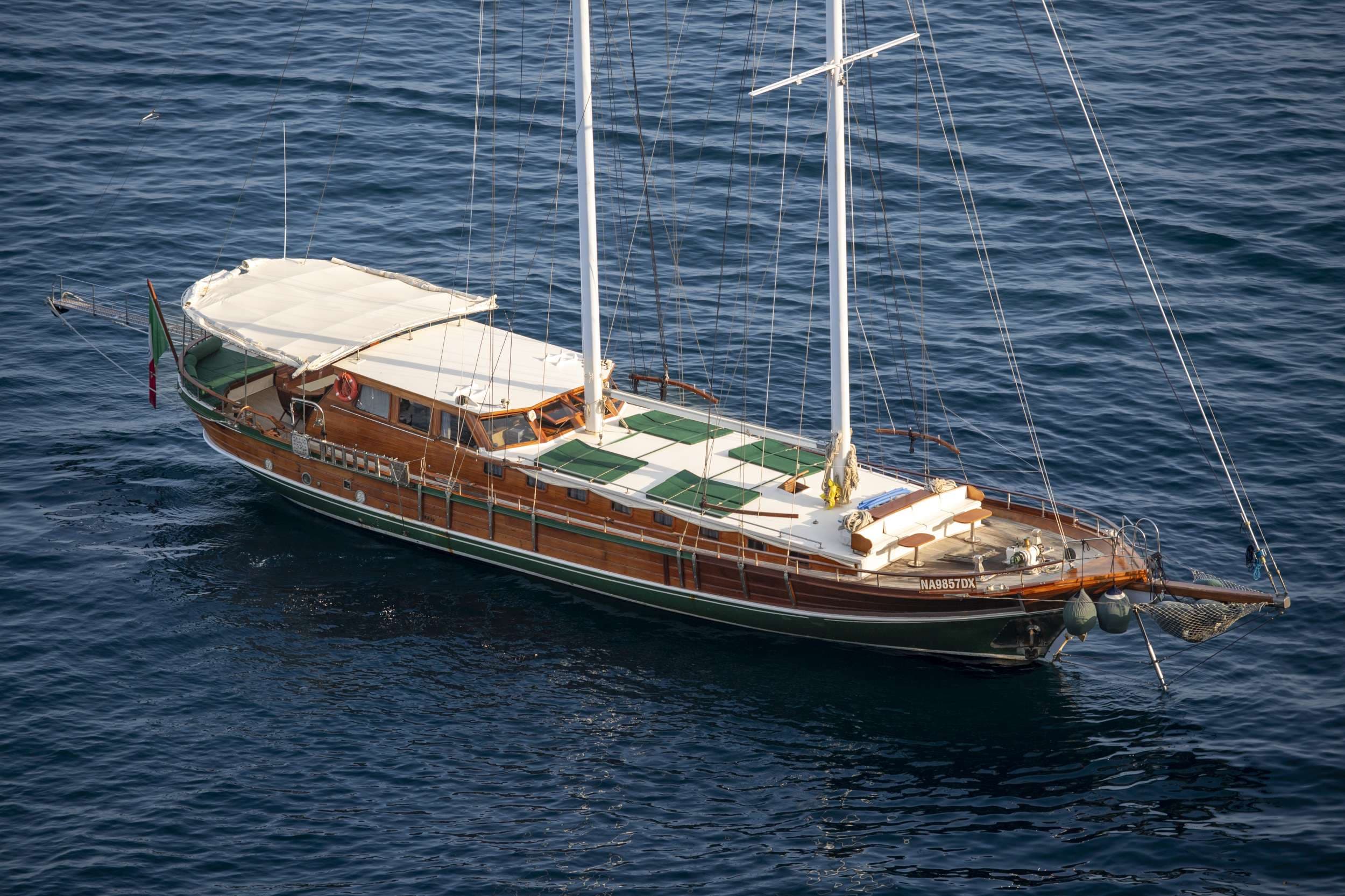
Turkey is the eastern edge of all this and a slightly different world. The Carian and Lycian coast is deeply indented, all headlands and inlets and pine-backed bays, which makes for unusually sheltered cruising. The gulfs of Göcek, Gökova and Hisarönü are calm and full of quiet coves with short hops between them, while the more open water around Bodrum and Datça gives a livelier sail when you want it under the summer Meltemi. This is the home of the gulet, the traditional wooden charter boat, and the relaxed, anchor-in-a-bay rhythm that goes with it. It tends to feel good value next to the western Mediterranean too. The bases are Bodrum, Göcek, Fethiye and Marmaris, reached through Dalaman and Bodrum airports. Turkey sits outside the EU, so a week that combines the Turkish coast with the nearby Greek islands, Kos, Symi or Rhodes are all close, means clearing customs on each side, which is routine but worth building into the plan.
Browse our fleet on the Turkish Riviera
See all →CARPE DIEM 5
Gulet47m
12 guests€31,500/wk
DE LOVE
Gulet47m
14 guests€70,000/wk
DRAGON FLY
Gulet39m
10 guests€31,500/wk
KAPTAN MEHMET BUGRA
Gulet34m
18 guests€25,200/wk
LEGASEA
Motor Yacht50m
12 guests€310,000/wk
LUCKY YOU
Gulet37m
10 guests€21,000/wk
PRENSES LILA
Gulet37m
16 guests€14,000/wk
PRENSES SELIN
Gulet37m
16 guests€14,000/wk
SANTA MARIA
Gulet23.9m
10 guests€10,000/wk
SERENAD
Gulet29m
12 guests€12,250/wk
When to go where
The Mediterranean charter season runs from around April or May into October, and the month you pick changes the character of a place as much as the place itself.
May and early June are the quiet, fresh start of the season. The water is still cooling off from winter, the crowds haven't arrived, and the prices are softer, though the weather is a little less settled and a few facilities are only just opening. It's a lovely time for couples and for anyone who'd rather have the bays to themselves. June and September are the two months we steer people toward most often, because across nearly all of these regions they tend to give you warm water, settled weather and room to breathe all at once.
July and August are peak summer, with the warmest sea and the longest days, and also the busiest harbours, the highest prices and, in the Aegean, the strongest Meltemi. None of that rules them out, especially for families tied to the school holidays. It just shapes where you'd point. In the height of summer we lean toward the sheltered grounds, the Ionian and Saronic in Greece, the Croatian islands, the Turkish gulfs, rather than the open Cyclades, unless you've a crew that actively wants the wind. The French Riviera is at its liveliest then too, which is the appeal for some and the reason to choose another month for others.
By late September and into October the season winds gently down. The water is still warm from the long summer, the light turns golden, and the crowds thin out, though the weather grows less predictable and the season closes earlier the further north and west you are. It's a quietly wonderful time to be out on the water if your dates are flexible.
What it costs, broadly
A crewed charter is usually quoted as a weekly fee for the yacht and her crew, with a few things on top, and it's worth understanding the shape of it before you start comparing regions. Alongside the fee you'll budget for running costs through an Advance Provisioning Allowance, which covers fuel, food, mooring and the rest, and we explain how that works in our guide to the APA. What is and isn't already included in the fee follows the MYBA standard, which we've broken down here.
Tax differs from country to country, and it's worth a plain word on it. A crewed charter starting in Greece that runs more than 48 hours is taxed at a reduced rate, currently 13%, and some yachts qualify for lower still. Croatia sits at 13% for a multi-day charter. Spain, and so the Balearics, is 21%. Italy is 22% and France 20%, in both cases with a reduction only for verified time spent outside EU waters. Turkey and Montenegro sit outside the EU system altogether, so a foreign-flagged charter there carries no EU VAT, with local permits and fees instead. The figure that actually lands on your contract depends on the specific yacht and where she sails, so rather than lean on a rule of thumb we confirm it for the boat you're considering.
The day-to-day cost of a region varies too, mostly through how you spend your nights. The grounds that are rich in anchorages, much of Greece, the Turkish gulfs, Corsica, let you swing on the hook for free a good deal of the time. The ones that lean on marinas, the Amalfi Coast and the French Riviera above all, carry higher mooring costs and want booking well ahead in summer. Neither changes the price of the yacht itself, but it does shape the running budget, and it's something we factor in when we talk through where to go.
Talk it through
There's no single winner here, and there doesn't need to be. There's a right region for your group, your dates and the kind of week you're after, and most of the work is simply matching those up.
So tell us what you have in mind. Whether it's a first, easy week with the children, a more ambitious week for a crew that knows what it's doing, a quiet anchorage every night or a lively harbour and a long dinner ashore, there's a stretch of this coast that fits, and usually a few boats on it we'd happily put you on. We'll talk it through, narrow it down, and once we've found the shape of the week we can get into the details with a preference sheet so the boat is set up exactly the way you like it.
Browse the fleet here, or get in touch and we'll help you find the right week on the water.
Browse Available Yachts | Contact Us | hello@frontieryachting.com | +32 487 22 08 22